the packaging archive
Every title and thumbnail change, with what it was before.
Analytics4You keeps a searchable archive of every title and thumbnail change on the channels you track — the old version beside the new one, timestamped — and detects when YouTube is running an A/B test by serving different packaging to different viewers. Where enough view samples exist around a change, it reports what happened to the view rate afterwards; where they do not, it says so instead of guessing.
YouTube Niche Monitoring Features▶ Watch the 1:28 walkthrough
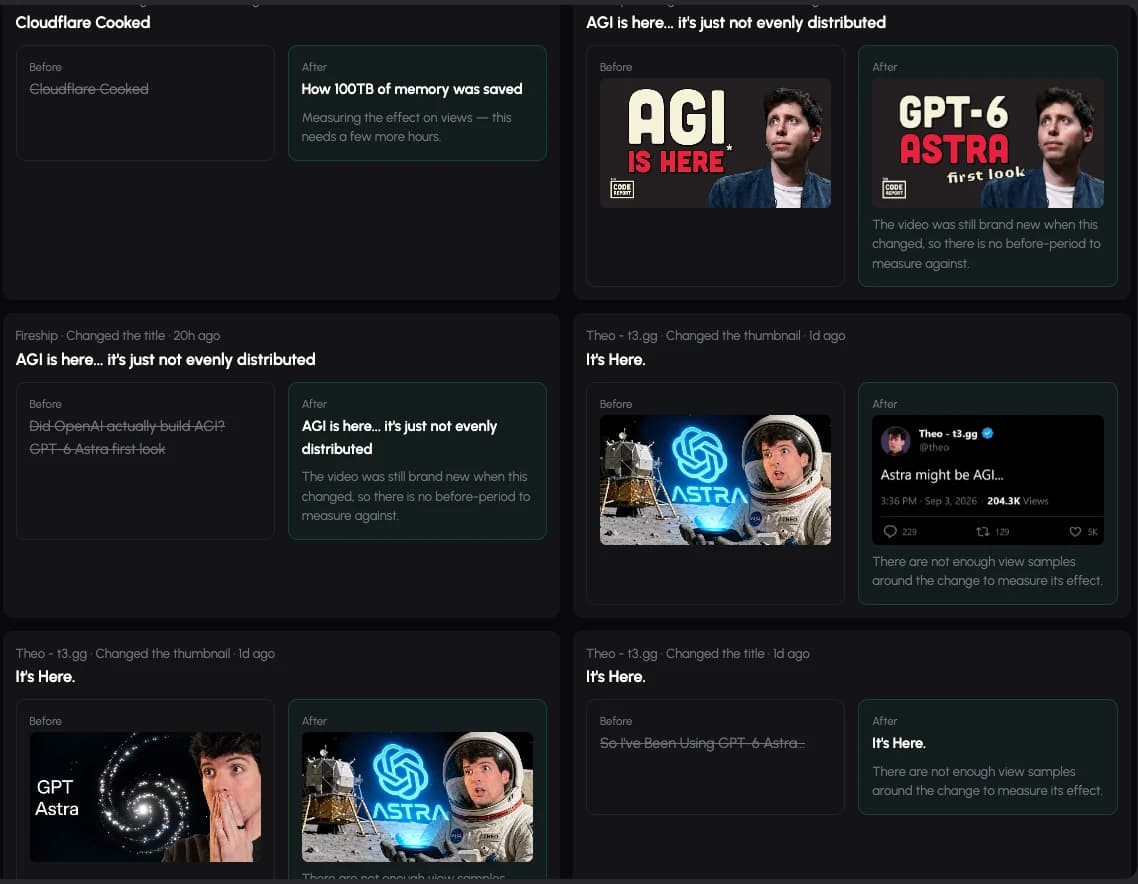
The old version is kept.
When a creator rewrites a title, the previous one is gone from YouTube. When they replace a thumbnail, the old image is gone too. The archive holds both sides: the title as it was, struck through beside the title as it is, and the previous thumbnail image next to the replacement.
That is what makes packaging studyable rather than anecdotal. You can see that a video was renamed twice in a week, what it was called each time, and which version is live now — across every channel in your niche, filterable by channel, by axis, by outcome and by date.
How an A/B test is detected.
YouTube runs packaging experiments by showing different titles or thumbnails to different viewers. One browser session cannot see that: it sees one variant and has no way to know a second exists.
So a probe is several independent browser identities, launched cold, arriving separately. If they come back with different packaging for the same video, that is an experiment, and every variant they saw is recorded. Those identities are never batched into one session and their number is never reduced to save capacity — batching them would defeat the measurement, so when the system is busy it probes less often rather than probing with fewer eyes.
Thumbnails need one more piece of care. The same image re-encoded by a CDN is not byte-identical, so comparing files would report a change every time YouTube re-compressed something. Images are compared by perceptual hash instead, and two hashes within a distance of six are treated as the same picture — a threshold that is frozen across the whole system so that hashes recorded a year apart still compare correctly.
Probing is bounded to the first three weeks after upload, which is the window in which YouTube actually runs these experiments, and an experiment that has not been seen for six hours reads as ended. When it ends, the winner is whichever recorded variant matches what the video is showing now — exact text for titles, the perceptual-hash rule for thumbnails. If neither matches, the creator picked a third option we never saw, and the record says the winner is unknown rather than naming one.
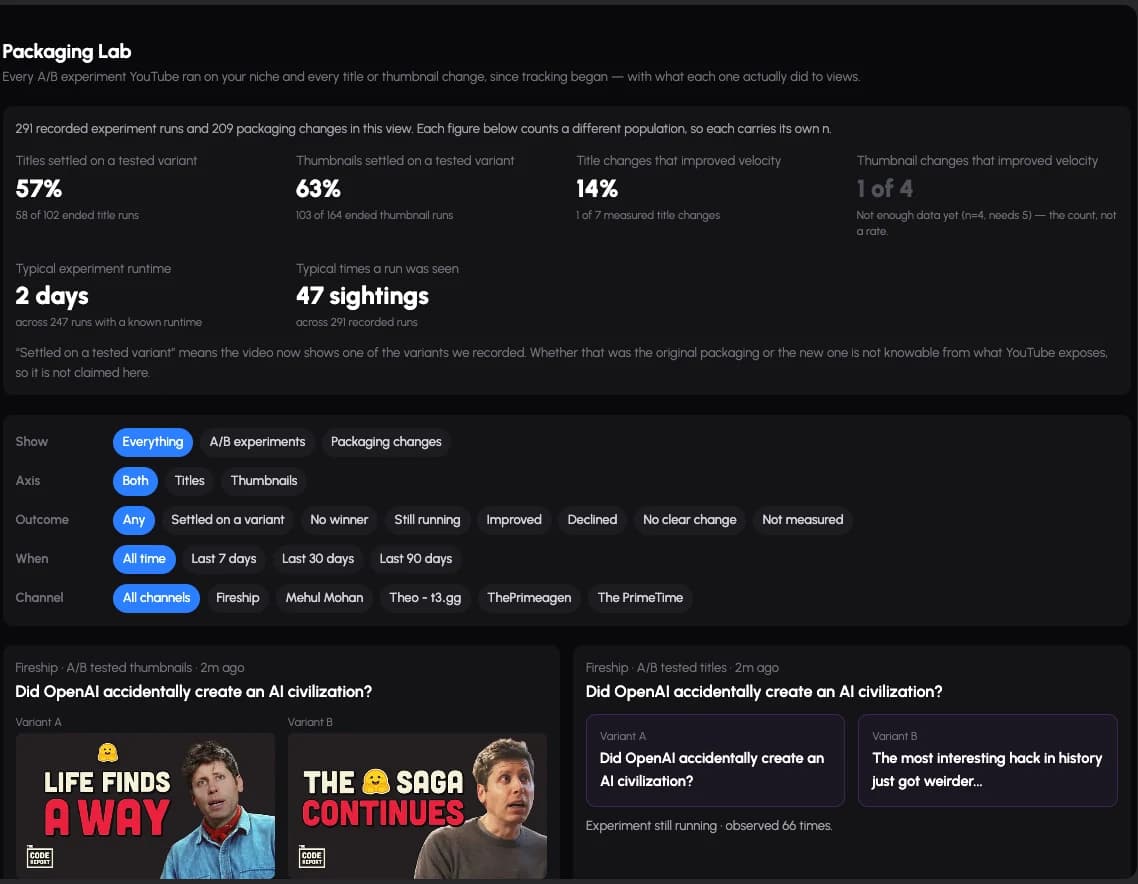
What the corpus adds up to.
Above the archive is the summary of everything recorded for your niche: how many experiment runs and packaging changes are in view, how often titles and thumbnails settled on a variant that was tested, how long a typical experiment ran, and how many times a run was seen.
Every figure carries its own n, because each one counts a different population. And when a population is too small to express as a rate, the panel prints the count and a note saying so rather than a percentage — “not enough data yet, the count, not a rate”. A percentage over four observations is a number that looks like evidence and is not.
The same rule governs the effect of a change. Where there are enough view samples on both sides of a swap, the record says whether the view rate improved, declined, or did not clearly move. Where the video was too new, or the samples too sparse, it says that instead. “Settled on a tested variant” is likewise stated carefully: it means the video now shows one of the variants that was recorded, and whether that was the original packaging or the new one is not something YouTube exposes, so it is not claimed.
where this stops
What it does not do.
- It records what was served and what changed. It does not generate titles or thumbnails, and it does not rate them — there is no language model in this product.
- It reports an effect only where the view samples support one. A change on a brand-new video has no before period, and that is what the record says.
- It cannot see the experiment YouTube did not serve to any of its probes, and it does not claim a winner it cannot match against the video’s current state.
questions
About the packaging.
How do you detect a YouTube A/B test?
By loading the same video through several independent browser identities that are launched cold and arrive separately. If they are shown different titles or thumbnails, YouTube is running an experiment, and every variant that was seen is recorded.
Are old thumbnails really kept?
Yes. The previous image is stored and shown beside the current one, which is the only way to see it once YouTube has replaced it.
How do you tell a real thumbnail change from a re-encode?
By perceptual hash rather than by file bytes. Two images whose hashes are within a distance of six are treated as the same picture, so a CDN re-compression does not register as a change. That threshold is fixed system-wide so old and new records stay comparable.
Do you say which variant won?
Only when the video’s current packaging matches one of the variants that was recorded. If the creator ended up with something we never observed, the record says the winner is unknown rather than picking one.
Can you tell me whether a title change worked?
Where there are enough view samples before and after the change, the record reports whether the view rate improved, declined or did not clearly move. Where there are not — a new video, or sparse sampling — it says that instead of estimating.
How long are videos probed for experiments?
For the first three weeks after upload, which is the window in which YouTube runs them. An experiment that has not been observed for six hours is treated as finished.
the rest of it
Three more views on the same record.
01 Feed
Track competitor YouTube channels in one stream.
Every change across the channels you track, in the order it happened.
02 Watchlist
Compare every channel in your niche, side by side.
One table for the whole niche, with a median row that shows its n.
03 Outliers
Find the videos beating their own channel.
Every tracked video, ranked by how far it is beating its own channel.